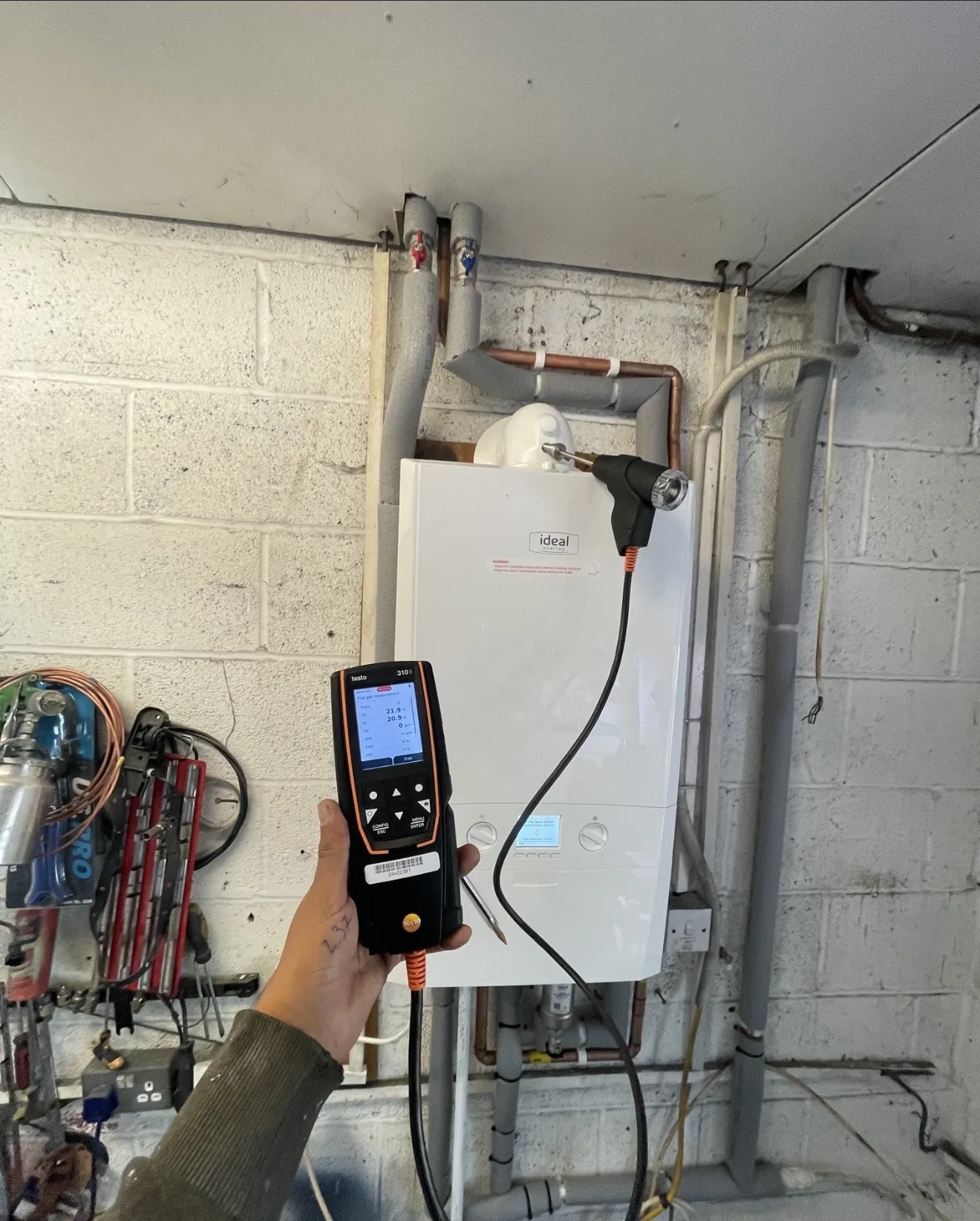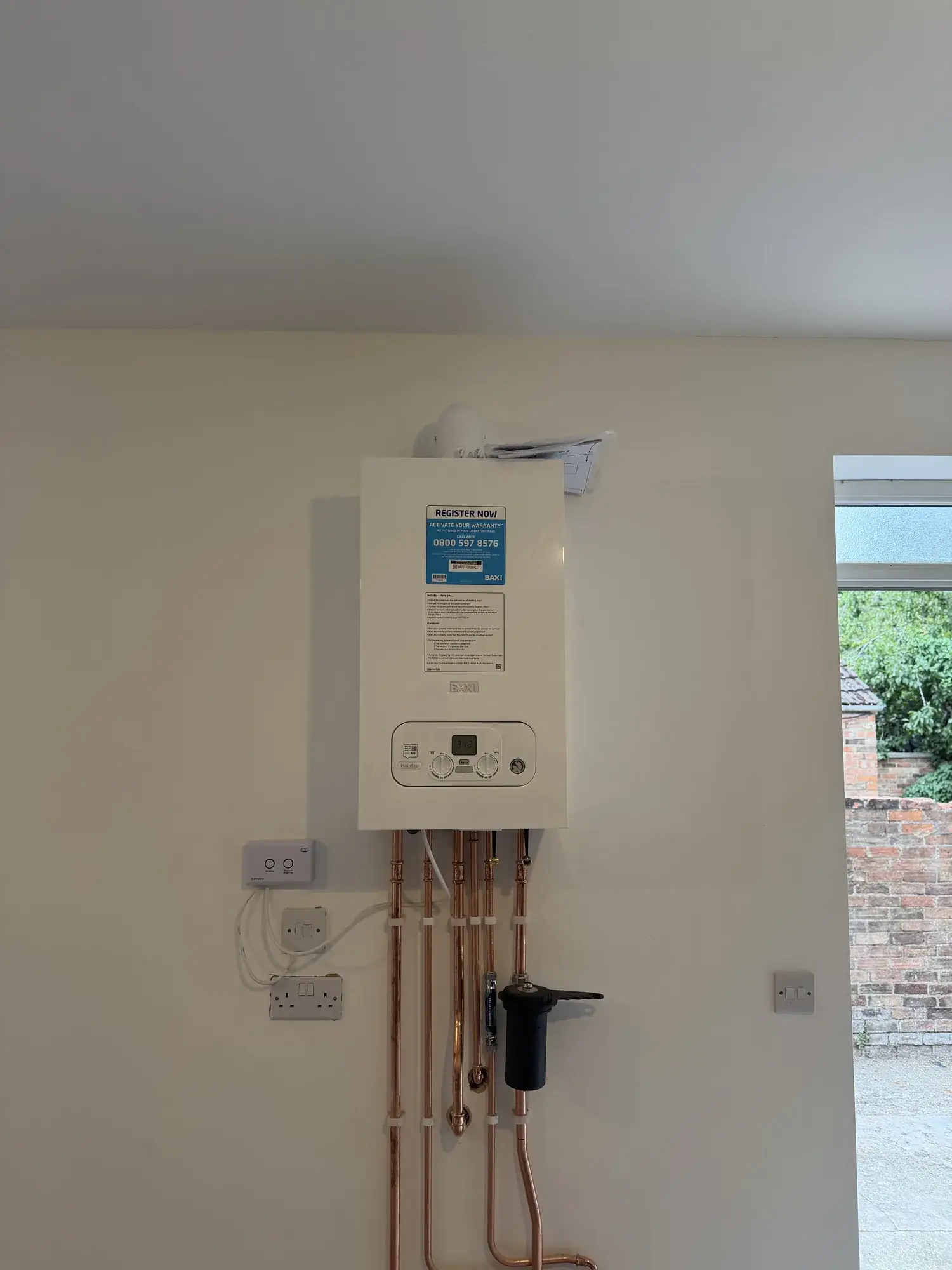
A boiler usually needs replacing once it is over twelve to fifteen years old and any of the following are true: rising energy bills, repeated breakdowns, a pressure gauge that keeps dropping, cold spots or slow heat up, yellow rather than blue flames, unusual banging or gurgling, or parts that are no longer made. A new boiler from Great Ouse Plumbing & Heating starts from £1,950 supplied and fitted across Bedford, Kempston and Milton Keynes.
Almost nobody replaces a boiler on a warm afternoon in September. They replace it on the first properly cold morning in December, when the shower runs cold and the house is full of people. What makes that frustrating is that the boiler had usually been dropping hints for months: a pressure gauge that needed topping up a bit too often, a radiator that took an age to warm through, a noise on start up that was not there last year.
The signs below are the ones worth acting on. Some of them mean a new boiler. Several of them mean a straightforward repair and nothing more, and we have said so plainly, because a decent engineer should tell you when your boiler has years left in it.
Signs One to Three: Age, Bills and Breakdowns
These three tend to arrive together, and together they are the strongest case for replacement.
- 1. The boiler is twelve to fifteen years old. Most domestic gas boilers are designed for a working life of around twelve to fifteen years. Age on its own is not a fault, and we see plenty of well serviced fifteen year old boilers running perfectly. What changes is the odds. Past twelve years, seals harden, heat exchangers scale up, and the cost of any single repair starts to look large next to what is left of the boiler's life.
- 2. Your heating bills are climbing without your habits changing. An older non condensing boiler can be running at roughly 70 to 80 percent efficiency, meaning a meaningful share of the gas you pay for goes out of the flue. A modern condensing boiler, correctly installed and properly controlled, sits well above 90 percent. If your usage has not changed but your bills keep creeping up, the appliance is very often the reason.
- 3. You are calling an engineer more than once a year. One breakdown is bad luck. Three call outs in two winters is a pattern. Once repair spending in a year approaches a third of the cost of a new boiler, and the boiler is already over twelve, replacement is usually the better value decision rather than the more expensive one.
A useful test: add up what you have spent on that boiler over the last two years, then ask what a new one costs. Our boiler installations start from £1,950 supplied and fitted, and a new boiler resets the clock on both reliability and running costs.
Signs Four and Five: Pressure and Cold Spots
These two are the most commonly misread. Both can point to a boiler at the end of its life, and both are far more often something much cheaper.
- 4. Pressure that keeps dropping. A sealed system should hold its pressure, typically between 1 and 1.5 bar when cold. Topping up once after a radiator bleed is normal. Topping up every week is not. It means water is leaving the system somewhere: a weeping radiator valve, a joint under a floor, a failed expansion vessel, or a pinhole in the heat exchanger. The first three are repairs. The last one, on an older boiler, is usually the end of the road.
- 5. Cold spots and a house that takes far longer to warm up. Radiators cold at the bottom and warm at the top almost always mean sludge and debris sitting in the system rather than a failing boiler. A power flush and a magnetic filter often transform it. If the radiators are clean and balanced and the boiler still cannot bring the house up to temperature in a sensible time, then the boiler is struggling, and that is a different conversation.
Not Sure Whether Yours Needs Repairing or Replacing?
Call Hasan on 07519 848846. We will look at the boiler, tell you honestly what it needs, and quote for the repair as readily as for a replacement. We cover Bedford, Kempston, Milton Keynes and the surrounding villages, with 24 hour callouts.
Call for Honest AdviceSigns Six and Seven: Flame Colour and Noises
The last two signs are the ones your senses pick up before any gauge does.
- 6. A yellow or orange flame instead of a crisp blue one. Gas burning correctly burns blue. A lazy yellow flame suggests incomplete combustion, which can produce carbon monoxide. On many modern boilers the burner is sealed behind the casing and you will not see the flame at all, which is exactly why the flue gas readings taken at a service matter. If you can see the flame and it is yellow, stop using the appliance and call a Gas Safe registered engineer.
- 7. Banging, kettling or gurgling that was not there before. Kettling, that rumbling boil sound like an old kettle, is usually limescale or sludge on the heat exchanger. Gurgling often means trapped air or a partially blocked condensate pipe, which in a cold snap can be as simple as a frozen pipe outside. Sharp banging on shutdown is worth investigating quickly. Most of these are repairs, but on a boiler already past twelve years, persistent kettling after a flush tells you the heat exchanger is going.
One safety point that overrides everything else on this page. If you smell gas, do not touch any electrical switches and do not try to diagnose it. Leave the property, and from outside call the National Gas Emergency Service on 0800 111 999. The same applies if a carbon monoxide alarm sounds: get everyone out into fresh air first, then call. Do not wait for a plumber before you make that call.
The Sign Nobody Expects: Parts No Longer Made
This one catches people out more than any other. A boiler can be running well, be perfectly safe, and still be effectively unrepairable because the part it needs is obsolete.
- Manufacturers support models for a limited period. Once a model has been discontinued for a number of years, spares such as printed circuit boards, fans and diverter valves become hard to source, then unavailable, then only available as expensive reconditioned units of unknown history.
- A cheap fault becomes a terminal one. A failed fan on a current model is a routine job. The identical failure on an obsolete model can mean days without heating while a part is chased, or no fix at all.
- Brands that left the UK market. Some boilers installed in the 2000s were made by manufacturers that no longer trade here. Parts support for those disappeared with them.
- It is worth knowing in advance. When we service a boiler we will tell you if parts availability is becoming a concern, so that a replacement can be planned in the autumn rather than forced in January.
Which of These Are Repairs, Not Replacements
Plenty of companies will read that list back to you as seven reasons to buy a new boiler. That is not honest, so here is the split as we see it on real jobs in Bedford.
- Usually just a repair: a single leaking radiator valve, a failed expansion vessel, a frozen or blocked condensate pipe, air in the system, cold spots caused by sludge, a faulty thermostat or timer, and most one off component failures on a boiler under about ten years old. Our central heating repairs are £280 to £450, and plumbing repairs are £120 to £300.
- Usually a replacement: a leaking heat exchanger, repeated major faults on a boiler over twelve years old, a boiler whose parts are no longer manufactured, and any appliance an engineer has classified as immediately dangerous.
- It depends, and we will tell you which: persistent pressure loss with no visible leak, kettling that returns after a flush, and a boiler that is undersized or oversized for the house it is heating. These need someone to actually look at the system rather than guess over the phone.
If the answer is a new boiler, installations start from £1,950 supplied and fitted, and we will explain what the price covers before any work begins. If the answer is a repair, we will say so, even though it is the smaller job.
Frequently Asked Questions
Around twelve to fifteen years for a typical domestic gas boiler. Serviced annually, kept at the right pressure and protected with a magnetic filter and inhibitor, plenty of boilers comfortably reach the top of that range. Ones that have never been serviced can fail well before twelve. Age alone is not a reason to replace a boiler that is running safely and efficiently.
Usually not. Losing pressure means water is escaping somewhere, and most of the time it is a radiator valve, a joint, or an expansion vessel that has lost its charge. All of those are repairs. It only points towards replacement when the leak is inside the boiler itself, typically from the heat exchanger, and the boiler is already old. An engineer can tell the difference in one visit.
A reasonable rule of thumb: if the boiler is over twelve years old and a single repair costs roughly a third of a new installation, or you have had several faults in two winters, replacement is normally the better value. Heating repairs with us are £280 to £450 and installations start from £1,950, so the maths is usually easy to work through once you have a firm quote for both.
Leave the property straight away. Do not switch anything on or off, do not use a light switch, and do not use your phone indoors. Open a door on the way out if you can, and once you are outside call the National Gas Emergency Service on 0800 111 999. They are the first call, not a plumber. Once the gas emergency service has made the situation safe, a Gas Safe registered engineer can look at the appliance.